//Training Topics

Leadership Training Topics That Hold Up Under Pressure

Every leadership topic taught in the two published courses and on the four sector pages, with the tier, the sector, and the ranks each one is built for stated on the row. This page carries standards, accountability, and communication; part two carries decisions, development, and fit.

The short answer

Thatcher Lewis teaches 20 leadership topics across two published courses, grouped into five themes: standards and accountability, communication under pressure, decisions when the clock is running, developing people, and making the training fit a specific agency. Frontline topics go deeper in the Essentials tier and command topics in the Executive tier. Every topic is rehearsed in scenario form and rewritten against the agency's own procedures before delivery, and every one is taught personally by Chief Jon Fehlman. This page is a decision matrix, not a catalog: use it to find the tier and the sector page that own the topic you care about.

Topics mapped
20
Course tiers
Two: Essentials, Executive
Sectors served
Four
Last reviewed
July 18, 2026
Reviewed for accuracy

Reviewed by Chief Jon Fehlman, founder and lead instructor, a career law enforcement leader serving since 1984, under our editorial policy. Where a row describes fire, EMS, or local-government practice, it states the firm's training approach for that service rather than first-person operational experience. Last reviewed .

How to read a row

Each topic is described three ways: what it means once someone has to do it, where it typically breaks down inside an agency, and how it is worked in scenario form. Every row then ends in the same three cells, which are the reason this page exists: the tier that goes deeper, the sector page carrying the applied version, and the ranks the topic is built for. If a row does not tell you where to go next, it has failed at its job.

Frontline tierTraining Tomorrow's Leaders Today
Where the frontline rows below go deeper: toolkits, accountability, the peer-to-supervisor transition, and tactical communication.
Command tierExecutive Leadership Growth
Where the command rows go deeper: strategic decisions, conflict between units, coaching, early intervention, and change.
Sector: policelaw enforcement leadership training
Carries the applied version of accountability, tactical communication, duty to intervene, and executive command topics.
Sector: firefire department leadership training
Carries safety culture, incident command leadership, post-incident review, and procedure alignment.
Sector: EMSEMS leadership training
Carries the correction structure, operational awareness, resilience, and documentation coaching.
Sector: local governmentpublic administration leadership training
A local-government and public-service partner sector, not an emergency-response one. Carries stewardship, cross-department work, change, and data-driven decisions.
Group 01

Standards, and the culture a leader tolerates

Four topics about the same mechanism seen from four angles: a standard is only real at the moment someone senior would rather not enforce it. These rows are where most agencies say their supervision problem actually lives.

Accountability & Credibility

Essentials

What it means in practice
Accountability is not the discipline file. It is a set of expectations stated out loud, applied to the strongest performer and the weakest one in the same week, and still explainable a month later without reaching for the personality of the employee. Credibility is the currency a supervisor spends every time they do that, and the only thing that makes the next correction land.
Where it breaks down in agencies
Agencies rarely lose the standard in one event. They lose it by exception: the veteran who always gets the good assignment, the report that is late every Friday and corrected by nobody, the rule that applies on days but not on nights. Once an exception is visible to the shift, the standard is understood to be negotiable, and every later correction reads as personal rather than procedural.
How it is taught, in scenario form
Participants take the supervisor's chair on a performance problem that has been tolerated for a year, deliver the correction, then defend the same decision twice: once to the employee's peer group, once to a superior who was comfortable with the old arrangement. Roles are inverted on the second pass so the experience of being corrected is felt, not described.
Primary source, for reference only
IACP: leadership resources (opens in a new tab)The association's published leadership material is where much of the profession's supervisory vocabulary comes from. Referenced for language only: no membership, approval, or endorsement is claimed in either direction.
Goes deeper in
Essentials teaches setting and holding the standard; Executive extends the same skill into early intervention and pattern data.
Applied version on
Law Enforcement: Culture, Ethics, and Accountability
Built for these ranks
Corporals, sergeants, FTOs, company officers, crew leads, civilian supervisors
Identifying Leadership Challenges

Essentials

What it means in practice
This is the skill of naming a problem before it has a name: the shift that has quietly split into two camps, the informal leader whose opinion outranks the supervisor's, the promotion that changed a title but not a habit. It also covers the specific and unglamorous work of leading people who were peers last month, including civilian staff who do not answer to rank at all.
Where it breaks down in agencies
The first-line promotion is where supervision most often breaks. The new supervisor either keeps every friendship and quietly drops the standard, or overcorrects and loses the room inside a week. Neither failure appears in a performance review. Both appear later as turnover, grievances, and a shift that routes around its own supervisor.
How it is taught, in scenario form
A participant is handed a roster, a stack of complaints, and a shift with a known informal power center, then has to say out loud where authority actually sits rather than where the organizational chart puts it, and take one concrete action that moves it back. The group critiques the action, not the person.
Goes deeper in
Essentials owns the peer-to-supervisor transition. Executive picks the thread back up as organizational culture rather than individual adjustment.
Applied version on
EMS Services: The friend-to-boss transition
Built for these ranks
Newly promoted sergeants, acting officers, company officers, crew leads, civilian staff

Safety Culture

Essentials

What it means in practice
Culture is the running total of what a leader walks past. In a station, a squad room, or a bay, tolerance is instruction: the crew reads what is permitted far more accurately than what is announced. The topic teaches leaders to treat small unsafe or unprofessional habits as the leading indicator they are, rather than as personality quirks to be managed around.
Where it breaks down in agencies
Standards erode in the direction of convenience, and they erode quietly. A shortcut that saves ten minutes gets used once under time pressure, then twice because nothing happened, then becomes the way it is done. By the time the shortcut is visible on an incident, it is no longer a decision anyone remembers making, and correcting it means correcting the whole crew's normal.
How it is taught, in scenario form
Crews work a sequence in which the same shortcut appears three times: first as a minor convenience in quarters, then as a habit, then on a call where it costs something. Participants have to choose the moment they would have intervened, and then actually deliver that intervention to a peer who does not want to hear it.
Primary source, for reference only
NFPA 1021: Standard for Fire Officer Professional Qualifications (opens in a new tab)The standard that defines what a fire officer is expected to be able to do. We reference it so departments can see where leadership behavior sits against their own officer-development expectations. Our courses are not an NFPA standard and carry no fire officer certification.
Goes deeper in
Essentials builds the daily correction habit. Executive addresses the same drift at department scale, where the fix is policy and command attention rather than a single conversation.
Applied version on
Fire Departments: Safety Culture and station leadership
Built for these ranks
Firefighters, acting officers, company officers, battalion chiefs

Ethics of Stewardship

Executive

What it means in practice
In local government, the ethical question is rarely whether something is legal. It is whether a defensible decision was made about money, staff time, and access that belong to residents rather than to the department that spends them. Stewardship treats a budget line as a trust to be justified, not an allocation to be defended, and it applies to public works and parks exactly as it applies to a police budget.
Where it breaks down in agencies
Ethical drift in local government is almost never dramatic. It is the vendor who is always the easy choice, the position quietly written around a preferred candidate, the analysis that arrives after the decision it was meant to inform. Each step is defensible on its own; the pattern is what a council, an auditor, or a reporter eventually sees, and by then it is a story about the organization rather than about a choice.
How it is taught, in scenario form
Department heads work a procurement and staffing decision where every option is legal and one is obviously convenient. They have to state the standard they are applying before they choose, then justify the choice in an open meeting to a room that has already read the convenient option in the agenda packet.
Primary source, for reference only
ICMA Code of Ethics (opens in a new tab)The professional ethics code city and county managers are held to. Decision models in this topic are aligned to it so the vocabulary matches the one participants already answer to. Alignment is not credentialing, and no ICMA credential is offered or implied.
Goes deeper in
This is command-level material: it assumes the participant sets policy rather than applies it, which is why it sits in the Executive tier rather than Essentials.
Applied version on
Public Administration: Ethics of Stewardship, the first of four pillars
Built for these ranks
City managers, county administrators, department heads, elected officials

The two rows above that live in the frontline tier are taught inside the Essentials course for first-line supervisors, and the stewardship row belongs to the Executive course for command staff.

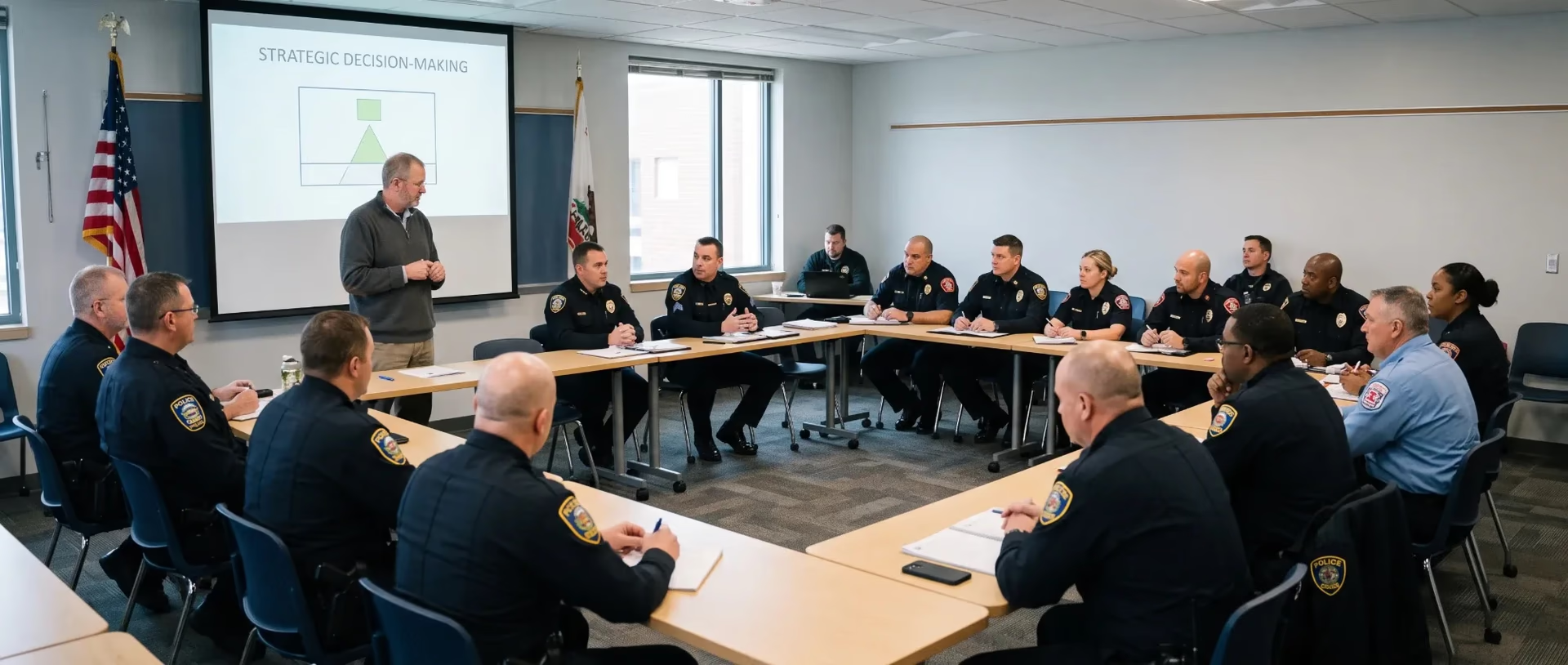
A wide view of a leadership training cohort mid-session, seated around tables in a classroom
How it is taught, in scenario form
Group 02

Communication that survives contact

Four topics about talking when it is expensive to talk. Two sit in the frontline tier because they are shift-level skills; two sit at command level because the friction is between units, agencies, or departments rather than between two people.

Tactical Communication

Essentials

What it means in practice
One discipline with three faces: de-escalating a person who does not want to be calmed, running a briefing and a debrief that people actually use, and speaking on a radio or a scene in words that survive being read back later in a deposition. The common thread is compression: saying the necessary thing, in the necessary order, when there is no time for the comfortable version.
Where it breaks down in agencies
Under stress, supervisors default to volume or to vagueness. Volume ends the conversation and costs credibility; vagueness leaves the crew to guess, and they guess in the direction of what is easiest. Both show up in the record, because the same imprecision that confused the scene also wrote the report.
How it is taught, in scenario form
Participants brief a shift, work a scene where the plan changes twice, then debrief the same event while the transcript of their own transmissions is on the table. The debrief is the assessment: it is easy to sound decisive in the moment and very hard to read back clean.
Goes deeper in
The frontline tier owns this outright. Executive assumes it and moves to messaging with elected officials, the community, and the press.
Applied version on
Law Enforcement: Briefings, scene control, and shift debriefs
Built for these ranks
Corporals, sergeants, FTOs, company officers, crew leads

Duty to Intervene and Critical Conversations

Essentials

What it means in practice
Two behaviors that fail for the same reason. Intervening means stopping a peer, sometimes a senior one, before a decision becomes an incident. A critical conversation means raising performance or conduct with someone whose respect you need tomorrow. Both require speaking against the social pressure of the room, which is a trainable skill rather than a character trait.
Where it breaks down in agencies
Agencies write the duty into policy and then never rehearse it, so the first time an officer has to interrupt a senior colleague is live, in public, with a bystander recording. The same gap appears in supervision: the conversation gets postponed until it can be attached to a formal action, at which point the employee experiences it as an ambush rather than a correction.
How it is taught, in scenario form
Short, repeated repetitions rather than one long exercise. Participants intervene early in a sequence where intervening is socially costly and factually correct, then run the follow-up conversation with the same person, on shift, the next day. Both halves are graded, because an intervention without the follow-up conversation usually costs a working relationship.
Primary source, for reference only
Bureau of Justice Assistance: VALOR Initiative (opens in a new tab)Federal officer safety and wellness work, referenced because the research on early intervention and post-incident support informs how this topic is sequenced. Referenced as published research, not as a program we deliver, are approved under, or are affiliated with.
Goes deeper in
Taught in the frontline tier as a supervisory and peer skill; Executive addresses the policy and early-intervention structure that has to exist around it.
Applied version on
Law Enforcement: Duty to Intervene and Critical Conversations
Built for these ranks
Officers, corporals, sergeants, lieutenants

Radical Accountability & Difficult Conversations

Essentials

What it means in practice
The EMS-facing version of the correction skill, built around a standards-first structure: open on the expectation, not the person; describe the observable behavior; state the correction; agree the check-back. It is deliberately repeatable, because supervisors who invent the conversation each time avoid having it.
Where it breaks down in agencies
In a staffing shortage, every supervisor is negotiating with the possibility that the person in front of them quits. That pressure turns correction into hinting, hinting into resentment, and resentment into a crew that believes standards apply to whoever is least likely to leave. Tardiness, sloppy handoffs, and clinical documentation problems all survive the same way.
How it is taught, in scenario form
Supervisors work a sequence of small, unglamorous corrections in a row: a late arrival, a rushed handoff, a narrative that does not support the care described. The same structure is used all three times so it is muscle memory by the third, and the last one is delivered to a partner the supervisor rode with for years.
Primary source, for reference only
National Association of Emergency Medical Technicians (NAEMT) (opens in a new tab)The practitioner association whose published guidance frames how EMS agencies talk about crew wellbeing and professional standards. This is leadership training, not clinical education: it carries no continuing-education credit and no clinical credential.
Goes deeper in
Frontline tier. The structure is the same one taught in the Essentials correction module, worked against EMS friction points.
Applied version on
EMS Services: Radical Accountability and Difficult Conversations
Built for these ranks
FTOs, crew leads, EMS supervisors

Advanced Conflict Resolution

Executive

What it means in practice
Negotiation and mediation applied where the disagreement is structural rather than personal: two divisions with incompatible priorities, a department and a union representative with the same facts and different obligations, two local-government departments each convinced the other creates their workload. The skill is separating the position from the interest without pretending the interests are identical.
Where it breaks down in agencies
Executives commonly resolve conflict by moving it: reassign the person, split the function, route the two parties through separate meetings. The friction disappears from the executive's calendar and reappears as duplicated work, contradictory guidance to staff, and a resident or a caller who gets a different answer depending on who picks up.
How it is taught, in scenario form
Two teams are given genuinely incompatible mandates and a shared deadline. A participant mediates without the authority to simply decide, then has to write the one-paragraph summary both sides will be held to. The written summary is where most attempts come apart.
Primary source, for reference only
National Association of Counties (NACo) (opens in a new tab)Publishes guidance on county governance and intergovernmental coordination, which is the environment this topic is worked in. Referenced as a source of practice literature; no affiliation or endorsement exists in either direction.
Goes deeper in
Command tier. It assumes participants already hold the frontline correction skills and are now arbitrating between units rather than inside one.
Applied version on
Public Administration: Cross-department synergy, breaking functional silos
Built for these ranks
Lieutenants, captains, watch commanders, department heads, deputy directors

Where a topic in this group is delivered for a specific service, the applied version sits on the sector page: police and sheriff leadership training or EMS supervisor and crew-lead development.

The matrix continues

Decisions, development, and fit

The remaining three themes — decisions when the clock is running, developing people, and making the training fit a specific agency — carry the command-tier rows.

Command & development topics

What these topics are not

None of the topics above is a certification, and completing them confers no credential. POST credit is not yet available: agencies submit our documentation to their own state board, and the full position is set out with what an agency receives for a training file. The outbound links on this page are citations that let you read a primary source and check our description against it. They carry no approval, membership, sponsorship, or affiliation in either direction, and where a source could not be verified reachable it was left out rather than published unchecked. Nothing here is legal advice. Corrections are welcome and handled through the Trust Center.

Know the topic you need? We will build the cohort around it.

Bring the two or three rows that describe your agency to a discovery call, or read answers on pricing, cohort size, and delivery first. Sessions run two to five days, on-site, live online, or hybrid, with an ideal cohort of 15 or more.